
Introduction
Enterprise SEO differs fundamentally from small-site optimization. With thousands or millions of pages, complex architectures, and multiple stakeholders, enterprise websites require systematic approaches to technical optimization, content organization, and ongoing maintenance.
This playbook addresses the unique challenges of enterprise SEO: managing large-scale technical implementations, coordinating across teams, maintaining consistency, and demonstrating ROI. Whether you're a Fortune 500 or rapidly scaling SaaS platform, these principles apply.
The Enterprise SEO Audit Checklist
Start with a comprehensive audit to identify optimization opportunities and technical issues. This checklist covers the four critical dimensions:
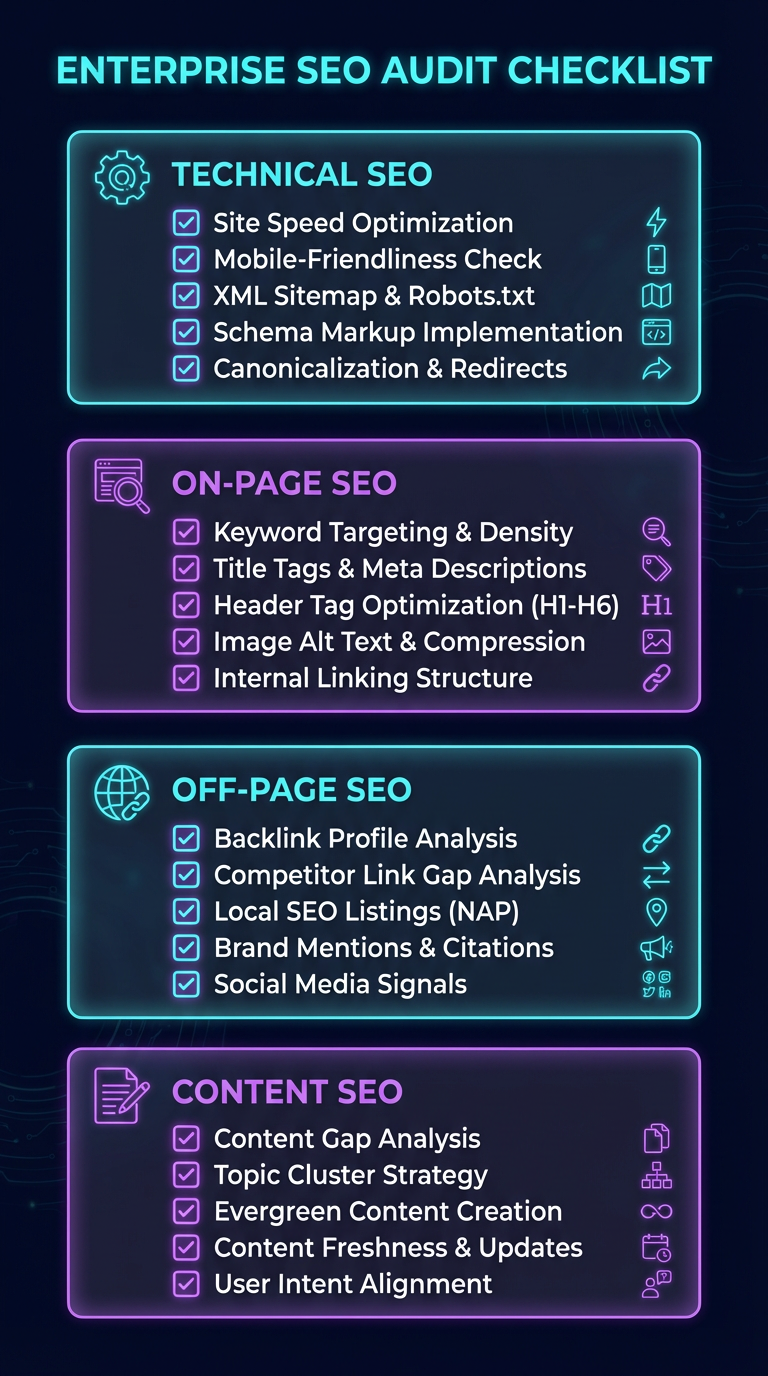
Technical SEO Fundamentals
Technical SEO ensures search engines can efficiently crawl, understand, and index your content.
Core Web Vitals
- LCP (Largest Contentful Paint): Under 2.5 seconds - optimize images, implement lazy loading, use CDN
- FID (First Input Delay): Under 100ms - minimize JavaScript, break up long tasks
- CLS (Cumulative Layout Shift): Under 0.1 - set dimensions for media, avoid dynamic content insertion
Crawlability & Indexability
- Submit and maintain XML sitemaps (split into multiple files if > 50k URLs)
- Optimize robots.txt to allow important pages, block staging environments
- Fix broken links and redirect chains (max 1 redirect per URL)
- Implement canonical tags to prevent duplicate content issues
- Ensure proper use of noindex/nofollow directives
Mobile Optimization
- Implement responsive design (not separate mobile URLs)
- Ensure touch elements are properly sized and spaced
- Test mobile usability in Google Search Console
- Optimize viewport and font sizing for mobile devices
HTTPS & Security
- Implement SSL certificates across all pages
- Update internal links to HTTPS
- Redirect HTTP to HTTPS (301 permanent)
- Fix mixed content warnings
Structured Data
- Implement Schema.org markup for rich snippets
- Use Organization, Article, Product, FAQ schemas as appropriate
- Validate structured data with Google Rich Results Test
- Monitor structured data in Search Console
On-Page SEO Essentials
On-page optimization focuses on content quality, keyword targeting, and user engagement signals.
Title Tags & Meta Descriptions
- Titles: 50-60 characters, include primary keyword, unique per page
- Descriptions: 150-160 characters, compelling copy, include call-to-action
- Avoid keyword stuffing, prioritize readability
Header Hierarchy
- One H1 per page containing primary keyword
- Logical H2-H6 structure for content organization
- Headers improve scanability and semantic understanding
Content Optimization
- Target keyword density: 1-2% (natural, not forced)
- Include semantic variations and related terms
- Minimum 800-1000 words for comprehensive topics
- Update content regularly to maintain freshness
Internal Linking
- Link to relevant related content within your site
- Use descriptive anchor text (not "click here")
- Distribute link equity to important pages
- Maintain reasonable number of links per page (50-100)
Image Optimization
- Use descriptive file names (product-name.jpg not IMG001.jpg)
- Write meaningful alt text for accessibility and SEO
- Compress images without losing quality (WebP format)
- Implement responsive images with srcset
Off-Page SEO & Link Building
Off-page SEO builds your site's authority through external signals, primarily backlinks.
Quality Link Building
- Guest posting on industry publications
- Digital PR and media outreach
- Resource pages and link roundups
- Broken link building strategies
Brand Building
- Social media presence and engagement
- Industry conference speaking
- Webinars and educational content
- Partnership announcements
Local SEO
- Google Business Profile optimization
- Local directory listings (NAP consistency)
- Location-specific landing pages
- Local reviews and reputation
Link Quality Signals
- Domain authority of linking site
- Relevance to your industry/topic
- Diversity of linking domains
- Natural anchor text distribution
Warning: Avoid black-hat tactics like buying links, link farms, or excessive reciprocal linking. Google penalizes these practices, potentially devastating your rankings.
Content Strategy & Planning
Systematic content creation targeting relevant keywords and user intent.
Keyword Research
- Identify high-volume, relevant keywords in your niche
- Analyze keyword difficulty and competition
- Focus on long-tail keywords (3+ words) for quicker wins
- Map keywords to user intent (informational, navigational, transactional)
Content Gaps Analysis
- Identify topics competitors rank for that you don't
- Find questions your audience is asking (Answer the Public, Reddit)
- Create pillar content for important topic clusters
- Build supporting content that links to pillar pages
Content Types
- How-to guides and tutorials
- Industry research and original data
- Case studies and success stories
- Comparison and "vs" pages
- FAQ pages targeting question keywords
Content Calendar
- Plan content 3-6 months in advance
- Balance evergreen and timely topics
- Coordinate with product launches and campaigns
- Schedule content updates for existing high-performers
Enterprise Site Architecture
Information architecture impacts both user experience and SEO performance. For enterprise sites with thousands of pages, proper structure is critical.
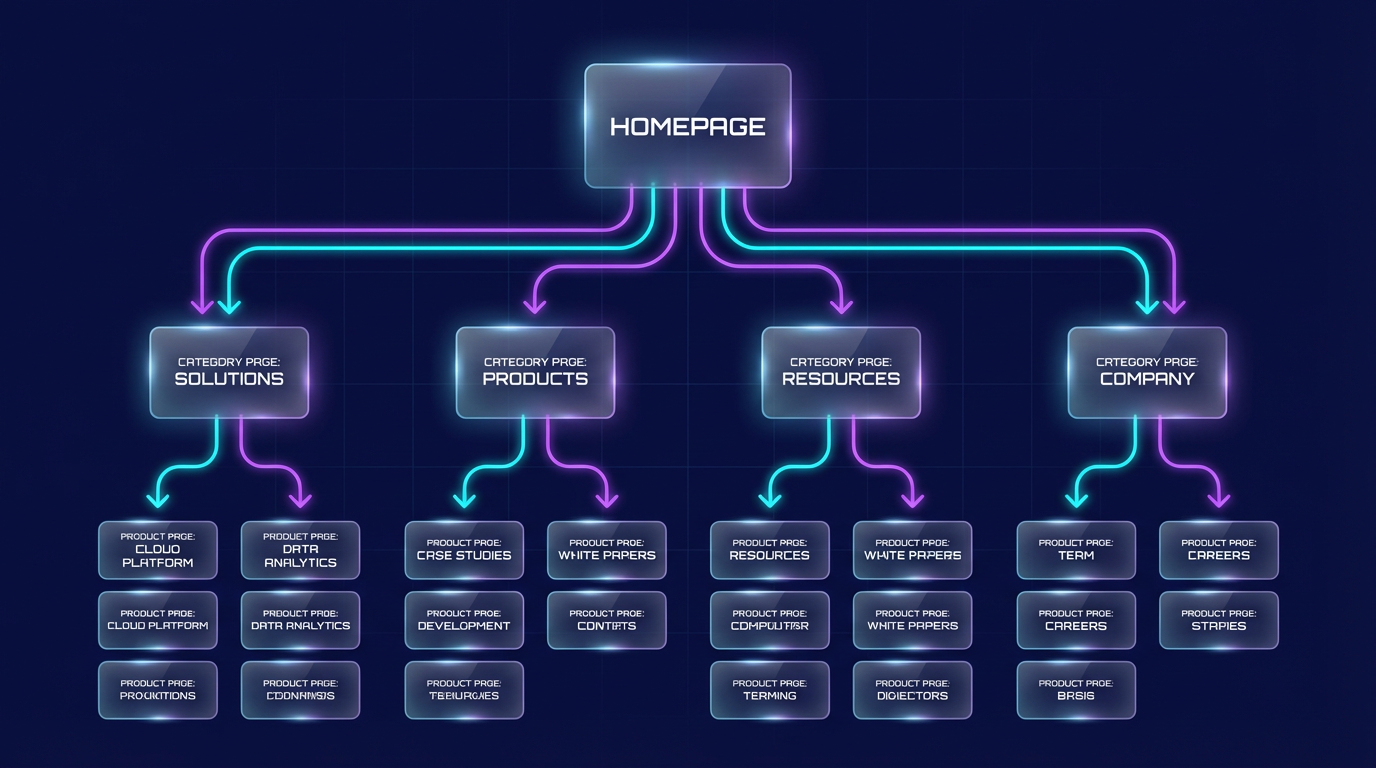
Flat vs Deep Architecture
Aim for flat site structure where important pages are within 3 clicks of homepage. Deep hierarchies dilute link equity and make pages harder to discover.
✅ Good: Homepage → Category → Product (3 clicks)
❌ Avoid: Homepage → Section → Category → Subcategory → Product (5 clicks)
Siloing Strategy
Group related content into topical silos to demonstrate expertise and authority in specific areas. Link heavily within silos, sparingly between them.
Example: E-commerce clothing site might have silos for Men's, Women's, Kids', each with subcategories and products.
URL Structure
Use clean, descriptive URLs that reflect content hierarchy and include keywords where natural.
✅ Good: example.com/products/running-shoes
❌ Avoid: example.com/p?id=12345&cat=shoes
Navigation Best Practices
Primary navigation should expose important categories. Use breadcrumbs for deeper pages. Implement faceted navigation carefully to avoid duplicate content.
International SEO Considerations
Enterprises operating in multiple countries or languages require specialized international SEO strategies:
URL Structure Options
ccTLDs (Country Code Top-Level Domains)
example.de, example.fr, example.co.uk
Pros: Strongest geo-targeting signal | Cons: Expensive, more domains to manage
Subdirectories
example.com/de/, example.com/fr/, example.com/uk/
Pros: Easy to manage, consolidated authority | Cons: Weaker geo-signal (Recommended for most)
Subdomains
de.example.com, fr.example.com, uk.example.com
Pros: Easier than ccTLDs | Cons: Treated as separate sites, dilutes authority
Hreflang Implementation
Hreflang tags tell search engines which language/region versions of pages exist. Critical for preventing duplicate content issues and serving correct version to users.
<link rel="alternate" hreflang="en-us" href="https://example.com/en-us/" />
<link rel="alternate" hreflang="en-gb" href="https://example.com/en-gb/" />
<link rel="alternate" hreflang="de" href="https://example.com/de/" />
<link rel="alternate" hreflang="x-default" href="https://example.com/" />
SEO Performance Measurement
Track these KPIs to evaluate SEO effectiveness and demonstrate ROI:
Primary indicator of SEO success
Track progress on important keywords
Title/description effectiveness
Ultimate business impact
Technical performance metrics
Off-page authority growth
Essential SEO Tools
Analysis & Reporting:
- Google Search Console (free, essential)
- Google Analytics 4
- Ahrefs or SEMrush (competitive analysis)
- Screaming Frog (technical audits)
Performance & Testing:
- PageSpeed Insights
- GTmetrix
- Google Rich Results Test
- Mobile-Friendly Test
Conclusion
Enterprise SEO is a marathon, not a sprint. Significant results typically take 6-12 months, but the compounding benefits of organic visibility make it one of the highest-ROI marketing channels.
Focus on fundamentals first: technical health, quality content, and natural link building. Avoid shortcuts and black-hat tactics that risk penalties. SEO is constantly evolving—commit to ongoing optimization and staying current with algorithm updates.
Maltha & Lane provides comprehensive SEO services for enterprise websites, from technical audits through ongoing optimization and content strategy. Our data-driven approach delivers measurable organic growth.