
Introduction
Digital transformation has evolved far beyond simply "going digital." In 2026, it represents a fundamental reimagining of how organizations create value, serve customers, and compete in increasingly digital markets. Yet despite billions invested annually, studies show that 70% of digital transformation initiatives fail to meet their objectives.
The difference between success and failure often lies not in technology choices, but in strategic planning, organizational alignment, and systematic execution. This guide provides a proven framework for enterprise digital transformation that addresses both technical and human dimensions of change.
What Digital Transformation Really Means
Digital transformation is the integration of digital technology into all areas of a business, fundamentally changing how you operate and deliver value to customers. It's also a cultural change that requires organizations to continually challenge the status quo, experiment, and get comfortable with failure.
Key Dimensions of Transformation
- Customer Experience: Reimagining how customers interact with your brand
- Operational Processes: Automating and optimizing core business functions
- Business Models: Creating new revenue streams and value propositions
- Culture & Workforce: Developing digital skills and adaptive mindsets
The 5-Stage Transformation Roadmap
Successful digital transformation follows a structured approach. Our five-stage framework has been proven across enterprises in finance, healthcare, retail, and manufacturing sectors.
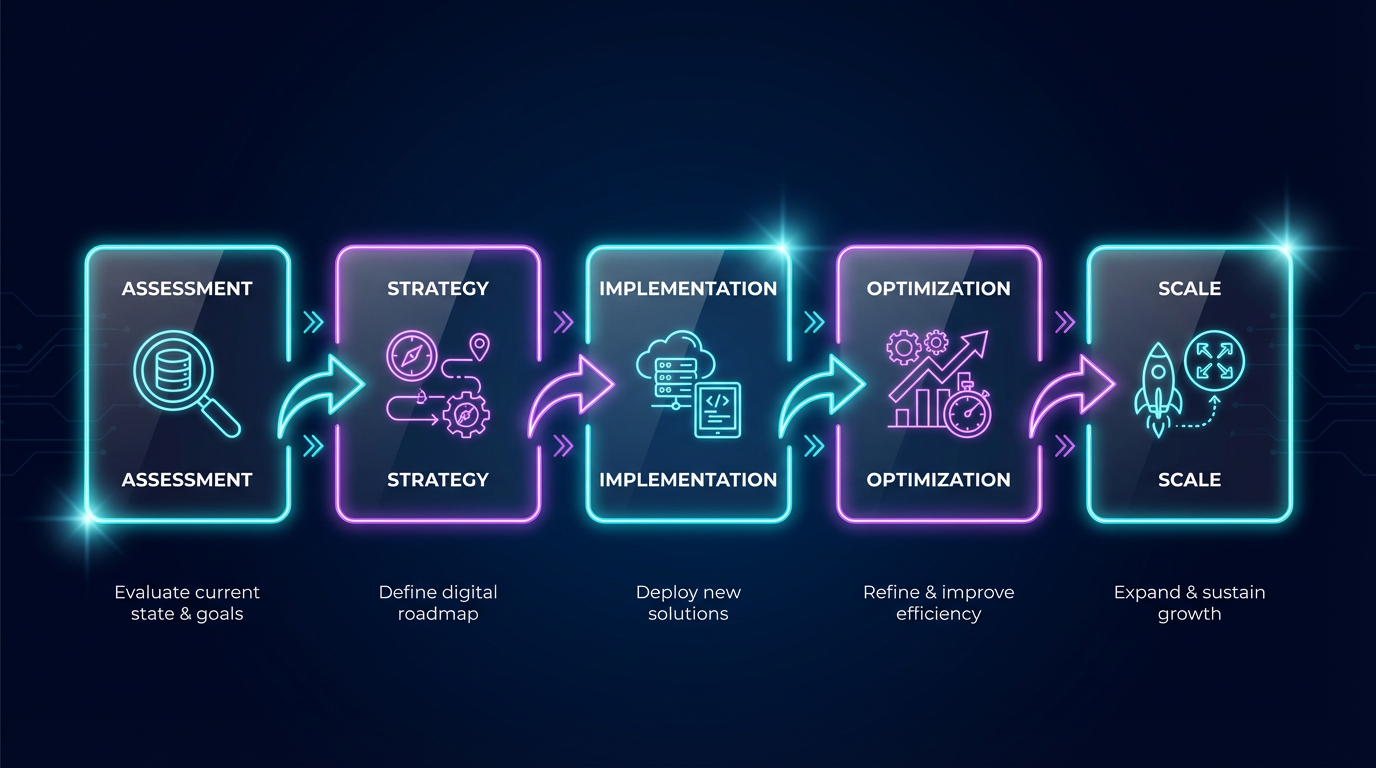
Stage 1: Assessment
The assessment stage establishes your baseline and identifies transformation opportunities. This involves comprehensive analysis across multiple dimensions:
- Digital Maturity Audit: Evaluate current technology capabilities, data infrastructure, and digital processes
- Customer Journey Mapping: Identify pain points and opportunities across the customer lifecycle
- Competitive Benchmarking: Understand where you stand relative to industry leaders
- Technology Stack Review: Assess legacy systems, integrations, and technical debt
- Skills Gap Analysis: Identify capability gaps in your workforce
Timeline: 4-8 weeks | Key Deliverable: Digital Transformation Readiness Report
Stage 2: Strategy
Strategy development translates assessment insights into a clear, actionable roadmap with defined priorities, resources, and success metrics:
- Vision & Objectives: Define the North Star and measurable outcomes
- Initiative Prioritization: Rank projects by impact, feasibility, and strategic alignment
- Resource Planning: Allocate budget, team, and technology requirements
- Governance Framework: Establish decision-making processes and accountability
- Risk Mitigation: Identify potential obstacles and contingency plans
Timeline: 6-10 weeks | Key Deliverable: Digital Transformation Strategy & Roadmap
Stage 3: Implementation
Implementation brings the strategy to life through structured project execution and change management:
- Agile Delivery: Deploy in iterative sprints with frequent releases
- Technology Integration: Build or implement new systems and platforms
- Process Redesign: Streamline workflows and eliminate inefficiencies
- Change Management: Prepare, equip, and support people through transition
- Training & Enablement: Develop skills through hands-on learning programs
Timeline: 6-18 months | Key Deliverable: Functional Digital Capabilities
Stage 4: Optimization
Optimization focuses on continuous improvement and maximizing return on digital investments:
- Performance Monitoring: Track KPIs and digital health metrics
- User Feedback Loops: Gather insights from employees and customers
- Process Refinement: Iterate based on real-world usage data
- Quick Wins: Identify and implement high-impact improvements
- Capability Building: Advanced training and skill development
Timeline: 3-6 months | Key Deliverable: Optimized Digital Operations
Stage 5: Scale
Scaling extends successful initiatives across the organization and prepares for future innovation:
- Expansion Planning: Roll out to additional departments, regions, or markets
- Platform Thinking: Build reusable components and services
- Ecosystem Development: Integrate partners, vendors, and third parties
- Innovation Pipeline: Establish processes for testing emerging technologies
- Continuous Transformation: Embed digital-first culture permanently
Timeline: Ongoing | Key Deliverable: Enterprise-Wide Digital Transformation
The Transformation Framework
Digital transformation must address four interconnected layers. Focusing on technology alone while ignoring culture, processes, or people is a recipe for failure.
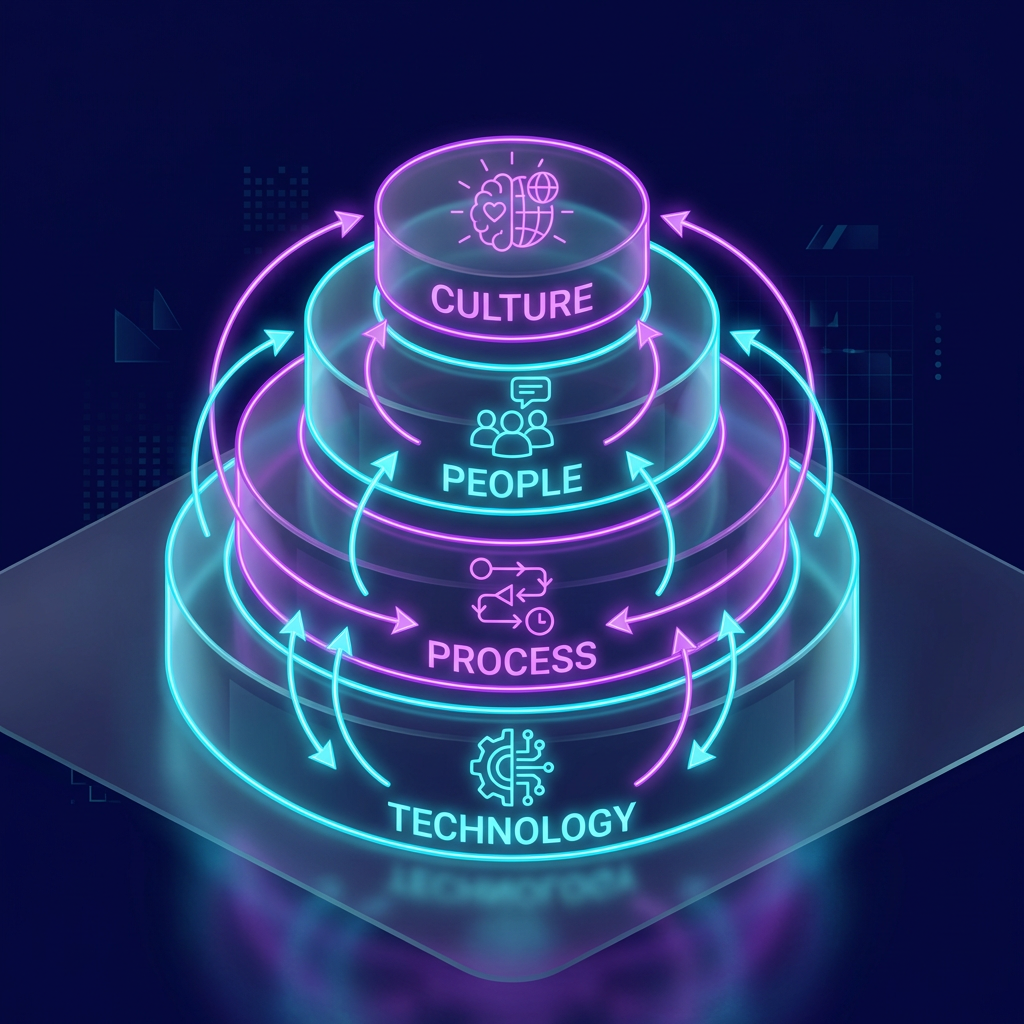
Technology Layer
Cloud infrastructure, data platforms, APIs, and modern application architecture that enables agility, scalability, and innovation.
Process Layer
Streamlined workflows, automation of routine tasks, data-driven decision making, and continuous improvement methodologies.
People Layer
Digital skills development, cross-functional collaboration, new roles and responsibilities, and ongoing learning programs.
Culture Layer
Leadership commitment, experimentation mindset, customer-centric thinking, and organizational willingness to embrace change.
Common Pitfalls to Avoid
Learn from organizations that have stumbled in their transformation journeys:
1. Technology-First Thinking
Buying the latest tools without understanding business needs or readiness. Technology is an enabler, not the goal.
2. Lack of Executive Alignment
When leadership isn't fully committed or aligned on vision, transformation initiatives lose momentum and resources.
3. Ignoring Change Management
New systems fail when employees aren't prepared, trained, or motivated to adopt them. People drive transformation.
4. Boiling the Ocean
Trying to transform everything at once. Start with high-impact pilots that demonstrate value and build momentum.
5. No Clear Success Metrics
Without measurable KPIs, it's impossible to know if you're succeeding or need to course-correct.
Measuring Transformation Success
Track these key metrics to evaluate your digital transformation progress:
Through automation and optimization
For new products and features
From new digital channels
Beyond the Numbers
Quantitative metrics tell part of the story. Also monitor qualitative indicators:
- Employee adoption rates and satisfaction scores
- Customer feedback and Net Promoter Score (NPS)
- Speed of decision-making and organizational agility
- Innovation pipeline and experimentation velocity
- Cultural shifts toward digital-first mindset
Conclusion
Digital transformation is not a destination but a continuous journey of evolution and adaptation. Organizations that succeed view transformation as an ongoing capability rather than a one-time project.
The five-stage framework provides structure, but success ultimately depends on leadership commitment, cultural readiness, and disciplined execution. Start small, demonstrate value, and build momentum. Every enterprise's journey is unique—the key is to begin with clear objectives and adapt as you learn.
Ready to accelerate your digital transformation journey? Maltha & Lane specializes in guiding enterprises through strategic transformation initiatives with proven frameworks and hands-on expertise.