
Introduction
Artificial Intelligence is no longer a futuristic concept—it's a practical business tool that enterprises across industries are leveraging to enhance decision-making, automate processes, and deliver personalized customer experiences. Yet the gap between AI pilots and production-ready systems remains substantial.
This guide provides a comprehensive framework for AI integration, from initial assessment through deployment and monitoring. Whether you're implementing predictive analytics, natural language processing, or computer vision, these principles apply across AI use cases and technologies.
When AI Makes Sense (and When It Doesn't)
AI is a powerful tool, but it's not always the right solution. Start by asking whether AI is genuinely needed for your use case.
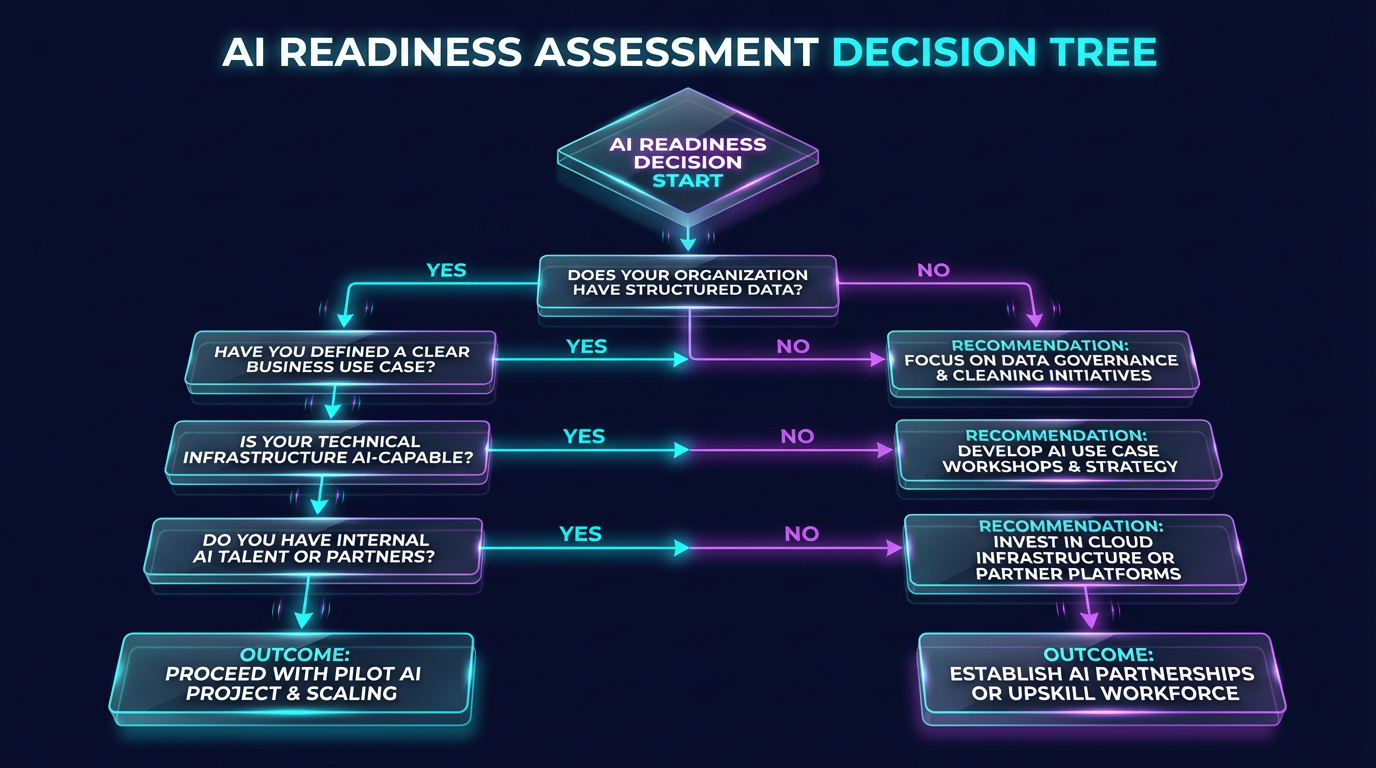
✅ Good Candidates for AI
- •Pattern Recognition: Detecting anomalies, fraud, or trends in large datasets
- •Personalization: Tailoring content, recommendations, or experiences to individuals
- •Prediction: Forecasting demand, churn, maintenance needs, or outcomes
- •Automation: Handling repetitive tasks at scale (customer service, data entry)
- •Content Analysis: Extracting insights from text, images, or voice data
❌ Poor Candidates for AI
- •Insufficient Data: Less than 10,000 quality examples for supervised learning
- •Rules-Based Logic: Problems easily solved with traditional if/then rules
- •High Stakes + No Explainability: Critical decisions requiring transparency
- •Rapidly Changing Domains: Where historical patterns don't predict future
- •Ethical Concerns: Potential for bias, discrimination, or harm
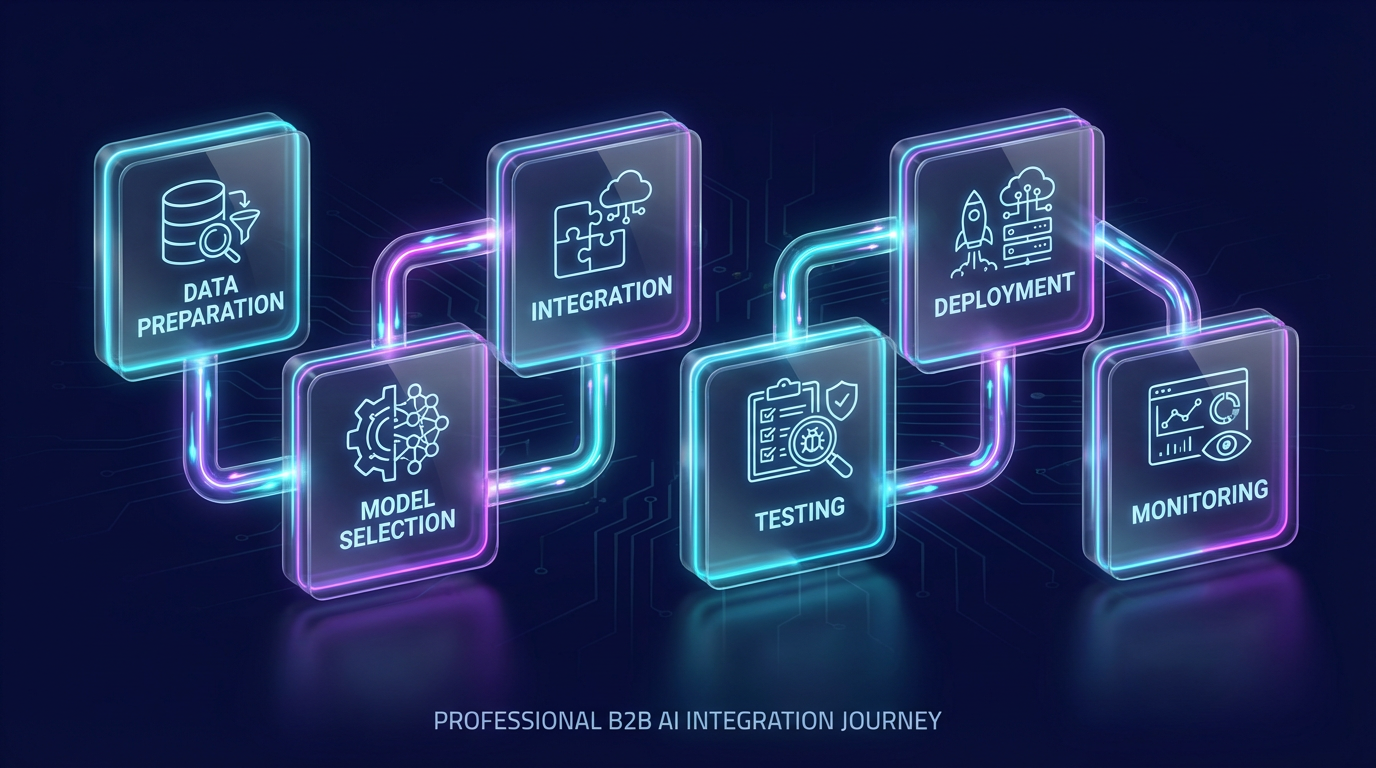
The 6-Phase AI Integration Process
Successful AI implementation follows a systematic approach from data preparation through production monitoring. Each phase builds on the previous, with feedback loops enabling continuous improvement.
Phase 1: Data Preparation
AI is only as good as the data it learns from. Data preparation typically consumes 60-80% of AI project time but determines success or failure.
Data Collection
Gather relevant data from internal systems, third-party sources, and historical records. Aim for quantity (thousands of examples) and quality (accurate, representative).
Data Cleaning
Remove duplicates, handle missing values, correct errors, and standardize formats. This unglamorous work is critical for model performance.
Feature Engineering
Transform raw data into meaningful features that capture patterns relevant to your business problem. Domain expertise is invaluable here.
Data Labeling
For supervised learning, accurately label training examples. Consider human-in-the-loop approaches for complex labeling tasks.
Timeline: 2-4 months | Key Deliverable: Clean, Labeled Training Dataset
Phase 2: Model Selection
Choose the appropriate AI/ML approach based on your problem type, data characteristics, and business constraints:
Prediction Problems
- Regression for continuous values
- Classification for categories
- Time series forecasting
Natural Language
- Large Language Models (LLMs)
- Sentiment analysis
- Named entity recognition
Computer Vision
- Object detection
- Image classification
- Semantic segmentation
Recommendation
- Collaborative filtering
- Content-based filtering
- Hybrid approaches
Pro Tip: Start simple. A well-tuned logistic regression often outperforms a poorly implemented deep learning model. Increase complexity only when simple approaches plateau.
Timeline: 2-4 weeks | Key Deliverable: Model Architecture Decision
Phase 3: Integration
Connecting AI models to your existing systems requires careful architectural planning:
- API Design: Create clean, versioned APIs for model inference
- Batch vs Real-Time: Determine whether predictions need to be instant or can be pre-computed
- Data Pipelines: Automate data flow from source systems to model inputs
- Fallback Logic: Define behavior when models are unavailable or confidence is low
- Security: Implement authentication, authorization, and data encryption
Integration Patterns
Embedded Models
Model runs within application
Model as Service
Separate microservice for predictions
Edge Deployment
Models run on client devices
Timeline: 4-8 weeks | Key Deliverable: Integrated AI System
Phase 4: Testing
Comprehensive testing ensures your AI system performs reliably across diverse scenarios:
Model Performance Testing
Evaluate accuracy, precision, recall, F1 score on held-out test sets. Analyze performance across different customer segments or use cases.
Edge Case Testing
Test unusual inputs, missing data, extreme values, and adversarial examples. AI should fail gracefully.
Integration Testing
Verify end-to-end workflows, API contracts, data transformations, and error handling.
Bias & Fairness Audits
Analyze predictions across demographic groups to detect and mitigate bias. Document fairness considerations.
Load & Performance Testing
Ensure system handles expected traffic with acceptable latency. Test scalability and resource consumption.
Timeline: 2-4 weeks | Key Deliverable: Test Results & Performance Report
Phase 5: Deployment
Deploy AI systems with risk mitigation strategies and rollback capabilities:
- Phased Rollout: Start with pilot users or limited geography before full launch
- A/B Testing: Compare AI-powered experience against baseline to validate improvements
- Shadow Mode: Run new models alongside existing systems without affecting users initially
- Feature Flags: Enable quick toggles to turn AI features on/off without code deployments
- Rollback Plans: Define criteria and process for reverting to previous version if issues arise
Deployment Best Practice: Use blue-green or canary deployment strategies. Never deploy directly to 100% of production traffic. Monitor closely during initial rollout period.
Timeline: 1-2 weeks | Key Deliverable: Production AI System
Phase 6: Monitoring
AI systems require ongoing monitoring because real-world data drifts over time, causing performance degradation:
Model Performance Metrics
- Prediction accuracy over time
- Confidence score distributions
- False positive/negative rates
System Health Metrics
- API response times (p50, p95, p99)
- Error rates and failure modes
- Resource utilization (CPU, memory)
Data Quality Metrics
- Input data drift detection
- Missing or anomalous values
- Distribution shifts
Business Impact Metrics
- Revenue or cost impact
- Customer satisfaction scores
- Operational efficiency gains
Set alerts for significant deviations. Plan model retraining cadence (typically monthly or quarterly) to maintain performance as data evolves.
Timeline: Ongoing | Key Deliverable: Monitoring Dashboard & Alerting
Technology Stack Considerations
The AI ecosystem offers numerous tools and frameworks. Choose based on your team's expertise, infrastructure, and specific requirements:
Machine Learning Frameworks
- TensorFlow/Keras: Production-ready, extensive ecosystem
- PyTorch: Research-friendly, dynamic computation
- scikit-learn: Classical ML, excellent documentation
- XGBoost/LightGBM: Structured data, competitive performance
MLOps Platforms
- MLflow: Experiment tracking, model registry
- Kubeflow: Kubernetes-native ML workflows
- AWS SageMaker: End-to-end managed service
- Azure ML: Enterprise integration, governance
LLM & NLP Tools
- OpenAI API: GPT models for text generation
- Anthropic Claude: Long-context understanding
- Hugging Face: Open-source model hub
- LangChain: LLM application framework
Data Infrastructure
- Feature Stores: Feast, Tecton for feature management
- Vector Databases: Pinecone, Weaviate for embeddings
- Data Warehouses: Snowflake, BigQuery for analytics
- Streaming: Kafka, Kinesis for real-time data
Change Management for AI Adoption
Technical implementation is only half the battle. Successful AI adoption requires organizational change management:
Executive Buy-In
Leadership must understand AI capabilities and limitations. Frame AI initiatives in business terms (revenue, cost, customer satisfaction) rather than technical metrics. Secure budget and resources for long-term investment.
Team Upskilling
Invest in training programs for data scientists, engineers, and business users. Build internal AI literacy across the organization. Create career paths that reward AI expertise and collaboration.
Transparent Communication
Address employee concerns about job displacement honestly. Position AI as augmenting human capabilities rather than replacing people. Share success stories and learnings openly.
Governance & Ethics
Establish clear guidelines for responsible AI use. Form ethics committees to review high-risk applications. Document decision-making processes and ensure explainability where required.
Conclusion
AI integration is a journey that requires technical expertise, organizational alignment, and patience. The six-phase framework provides structure, but success depends on starting with clear business objectives, assembling the right team, and committing to iterative improvement.
Don't aim for perfection in your first AI project. Instead, focus on delivering measurable value quickly, learning from real-world deployment, and building momentum. Each successful project creates capabilities and confidence for more ambitious initiatives.
Maltha & Lane specializes in helping enterprises navigate AI integration from strategy through production deployment. Our team combines deep technical expertise with practical experience scaling AI across diverse industries.